Overview
At a glance
- Formal-compatibility study, not a derivation
- Two candidate directions from Paper B §B.12.1
- Three mathematical resources considered together
- Verdict undetermined, neither demonstrated nor ruled out
- Information parameter treated as an entropy-like proxy, not Shannon entropy
Paper C examines whether the mathematical apparatus introduced in Mathematical Framework for Multi-Scale Recursive Dynamics: From Quantum to Cosmic Scales, published as Part III of the original Universal Recursive Dynamics series, can support a formal characterization of register consistent with Papers A and B. It is a study of formal compatibility, not a revision of the earlier mathematics or a derivation of register.
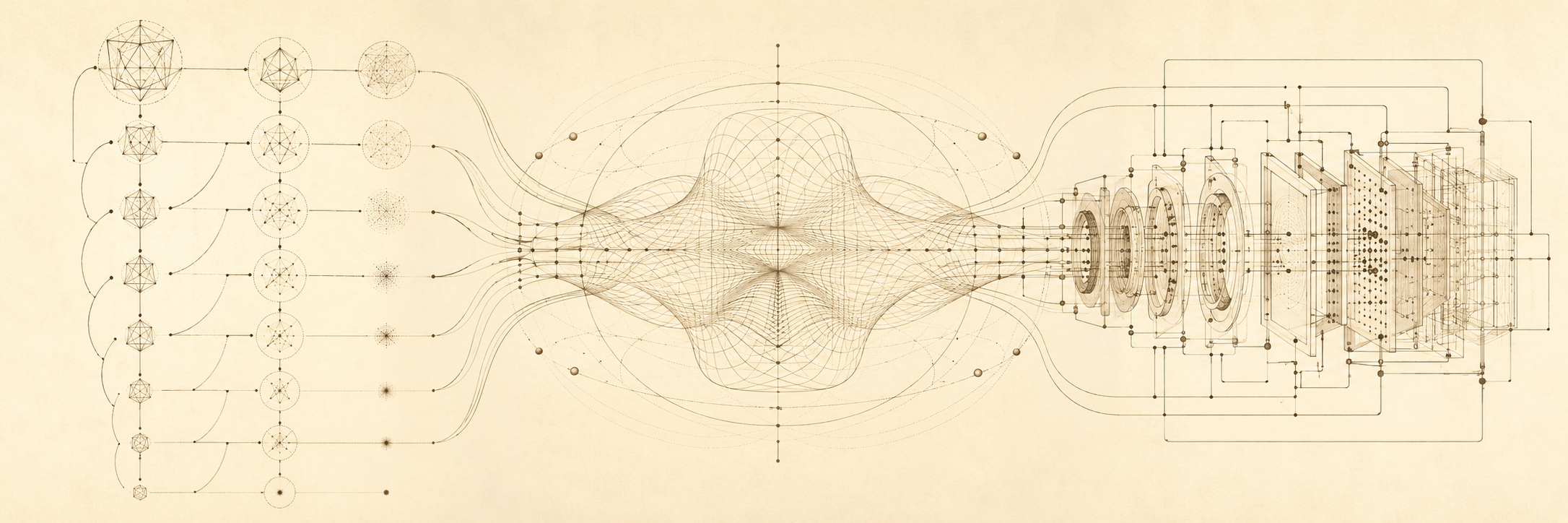
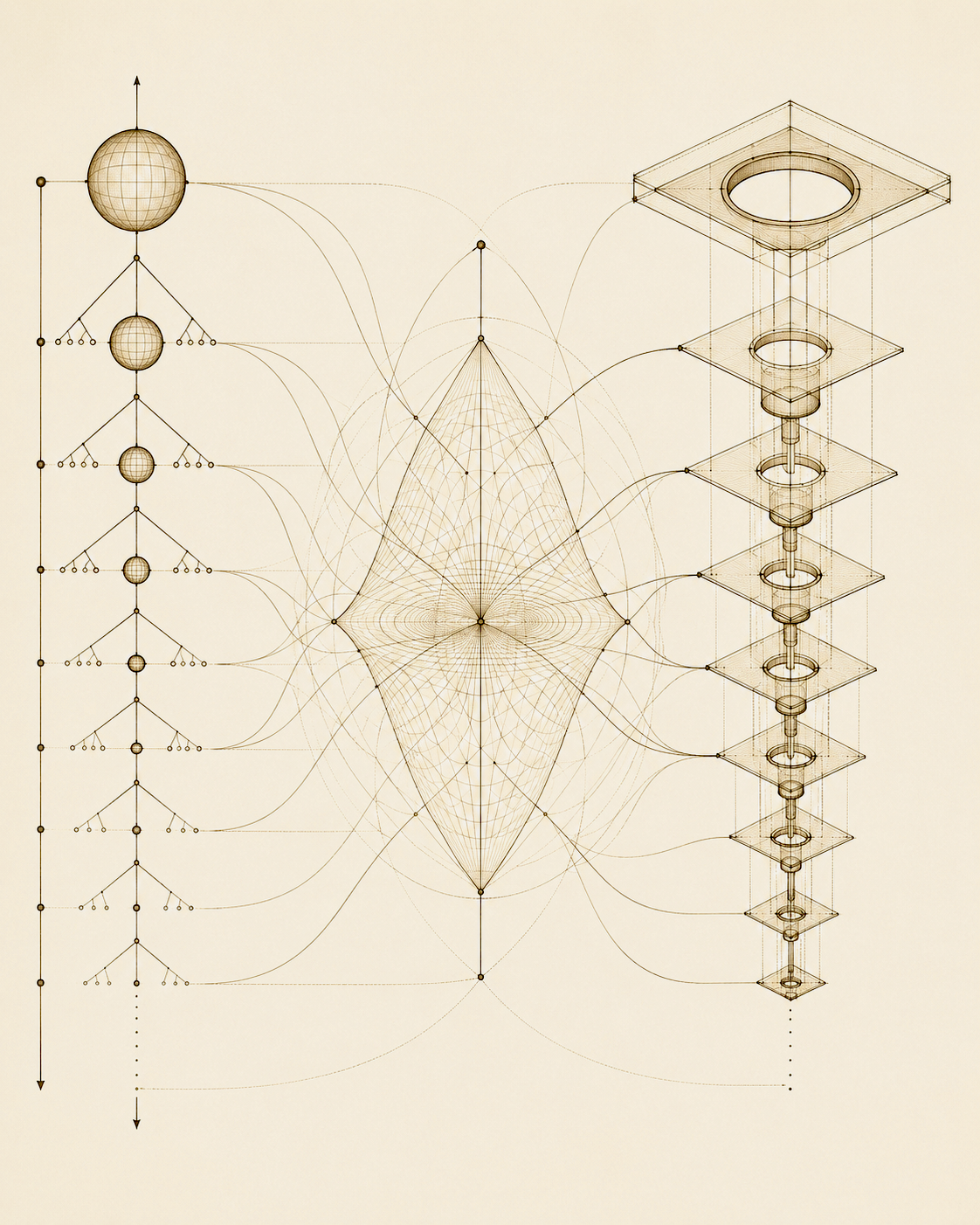
The paper considers two candidate directions identified in Paper B §B.12.1. The first concerns relationships among register’s axes, examined through Jacobian and Gram-matrix constructions, with a separately proposed extension for cross-system mutual conditioning. The second considers saturation dynamics as possible resources for representing modal events and register expansion. To investigate them, the study considers how three mathematical resources might operate together. These are the Mathematical Framework paper’s coupled-dynamics architecture (equation 12), a proposed per-scale saturation index, and parameter-space trajectories. They offer candidate starting points for representing cascade conditioning, modal events, and register expansion, but their correspondence to those features remains unestablished.
The mathematical findings are conditional, and formal compatibility remains undetermined. It has neither been demonstrated nor ruled out. State mappings, coupling definitions, event conditions, and a criterion distinguishing register expansion from other change must still be specified. The paper treats the Mathematical Framework paper’s information parameter as an entropy-like formal proxy, not as Shannon entropy, because its defining equation provides no probability distribution. Its relation to the framework’s broader, still unformalized sense of information remains open. Interpretive assumptions and pressure-test points are identified throughout, and empirical mapping to validation markers is deferred to later investigation.
What it claims / What it does not claim
What it claims
Bounded mathematical results. The logistic-core derivatives and the Jacobian and Gram-matrix constructions have the conditional mathematical properties the paper states. Those properties do not establish the proposed modal or register interpretations.
A candidate synthesis. Coupled dynamics, per-scale saturation indices, and parameter-space trajectories are proposed as one possible route toward representing cascade conditions, modal events, and register expansion. The paper identifies the definitions, assumptions, and tests that route would require.
A stated verdict. For the constructions examined, formal compatibility is undetermined. It has neither been demonstrated nor ruled out.
What it does not claim
Not a derivation. The paper does not revise the earlier mathematics, derive a model of register, or commit Paper B to a particular formal route. The adequacy and uniqueness of the proposed route remain unresolved.
No modal event from the calculus alone. The paper rules out treating the logistic-core derivative calculation, or the existence of a post-threshold trajectory, as sufficient to establish a modal event or register expansion.
An unresolved information frontier. The Mathematical Framework paper’s information parameter is treated as an entropy-like formal proxy, not as Shannon entropy. Its relation to the framework’s broader, still unformalized sense of information remains open.
Figures