Overview
At a glance
- Register as accumulated topology of measure-affected
- First-/second-order exchange as modal distinction
- Aperture, lens, five vectors, nested cascade
- Continuation-conserving dynamics
- Cautious AI section; open frontiers gathered
Paper B specifies the above-threshold operational architecture of register within the Universal Recursive Dynamics framework. Where Paper A develops the originary structural conditions under which register becomes possible, Paper B asks how register operates once those conditions are in force within the temporal field.
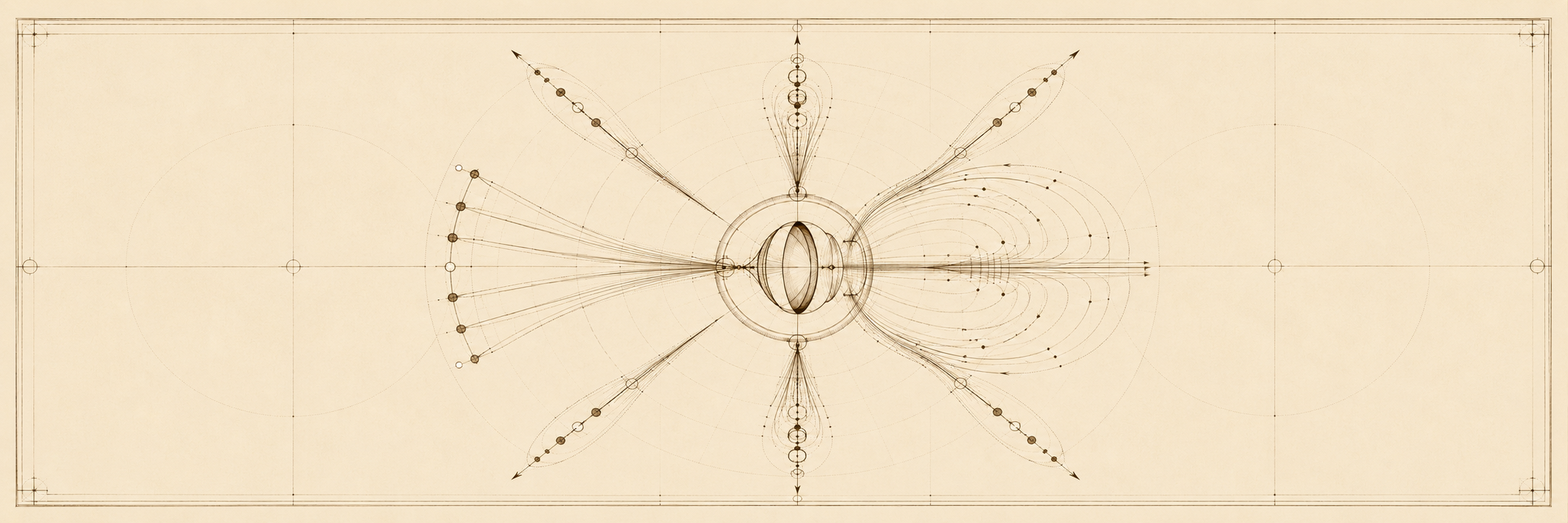
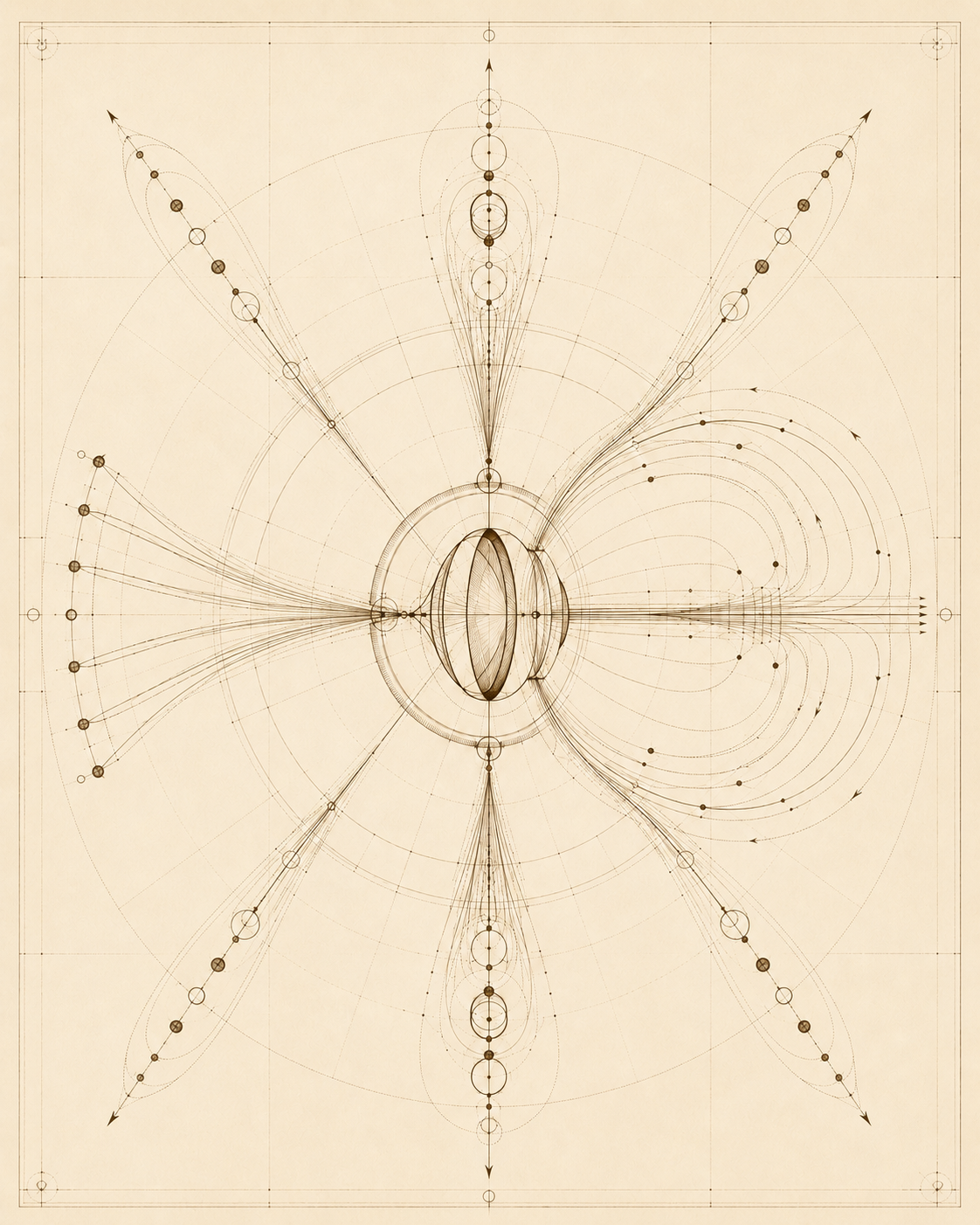
The paper develops register as the accumulated topology of measure-affected: what information exchange leaves, what subsequent exchange operates within, and what configures continuity across events. It distinguishes first-order exchange from second-order exchange as a modal distinction, not a developmental hierarchy. It then specifies the operational functions through which register operates: aperture as permeability regulation, lens as integration shape, the five vectors as homogeneous aspects of register, and the nested cascade as the structural form across which register-bearing systems are conditioned.
It also develops continuation-conserving dynamics as a replacement for adaptive-for-X grammar, modulation wisdom as the developmental character through which register-configuration carries integration without buckling, and non-teleological directionality as a within-regime principle. Its AI section is cautious: the framework specifies questions, criteria, and structural risk shapes, but does not assert that any present or future AI system instantiates consciousness, sentience, experience, or second-order exchange. Section B.11 engages neighboring frameworks — the Free Energy Principle, the entropic brain hypothesis, and Integrated Information Theory — without claiming convergence; Section B.12 gathers the open frontiers the architecture leaves unresolved.
Paper B is the second of a foundational pair. It rests on Paper A’s originary commitments; Paper A’s commitments are not symmetrically dependent on Paper B’s operational specifications. A companion technical note and Reader’s Guide accompany the deposit set.
What it claims / What it does not claim
What it claims
An operational architecture of register. Register specified as the accumulated topology of measure-affected, operated through aperture, lens, the five vectors, and the nested cascade, with first- and second-order exchange distinguished as a modal — not developmental — difference.
A vocabulary for continuity. Continuation-conserving dynamics, modulation wisdom, and non-teleological directionality as within-regime principles, offered in place of adaptive-for-X grammar.
What it does not claim
No verdict on machine minds. By the paper’s own statement, the framework does not assert that any present or future AI system instantiates consciousness, sentience, experience, or second-order exchange — it specifies questions, criteria, and structural risk shapes only.
Engagement, not convergence. The Free Energy Principle, entropic brain hypothesis, and Integrated Information Theory are engaged without claiming convergence, and the architecture’s open frontiers are consolidated rather than resolved.
Figures